 Tiếng Việt

In 2024, the patient attended a routine health check-up at Hanoi French Hospital and was advised to undergo a comprehensive cardiovascular evaluation due to symptoms of dyspnea, and a neurological assessment due to weakness in their limbs. During the assessment, cardiology and neurology specialists suspected a rare condition involving both the cardiovascular and nervous systems.
To further investigate, the patient underwent additional clinical assessments and imaging studies, including echocardiography. Findings initially suggested hypertrophic cardiomyopathy, with suspicion of amyloidosis, a rare disorder affecting both the heart and peripheral nervous system. The neurological examination gave arguments for a peripheral neuropathy that could explain the motor weakness.
To confirm the diagnosis, Dr. Sabrina Stefanizzi of the Dept. of Neurology at Hanoi French Hospital collaborated with international partners to perform genetic testing and analyze salivary gland biopsy samples. Results identified a heterozygous variant c.157T>C (p.Phe53Leu), a mutation associated with hereditary transthyretin amyloidosis (hATTR), which is a very rare condition in Vietnam . The biopsy findings further confirmed the diagnosis.
Hereditary transthyretin amyloidosis is a rare genetic disorder caused by mutations in the TTR gene, leading to abnormal deposition of amyloid protein in multiple organs, including the heart and nervous system.
Dr. Sabrina Stefanizzi stated: “Hereditary transthyretin amyloidosis can lead to heart failure, peripheral neuropathy, muscle weakness, orthostatic hypotension, and can be fatal if left undiagnosed and untreated. The treatment goal is to prevent amyloid buildup which improves the patient’s quality of life and prevents further complications.”
Following confirmation of the diagnosis, the experts at Hanoi French Hospital discussed treatment options in detail with the patient. Unfortunately, the latest and most effective medical treatments were not available in Asia. The patient continued regular follow-ups with Dr. Stefanizzi to monitor disease progression, alongside Dr. Pham Thu Thuy, from the HFH Department of Clinical and Interventional Cardiology.
By early 2026, progressive myocardial infiltration had led to heart failure, despite the patient’s stable neurological condition. Dr. Stefanizzi, Dr. Thuy and specialists at Viet Duc Hospital determined that definitive treatment would require combined heart and liver transplantation.
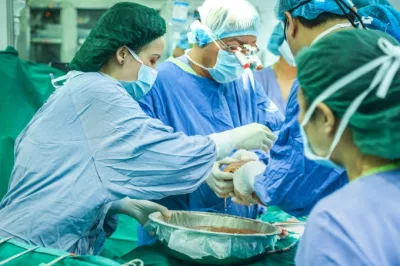
On March 13, Viet Duc Hospital successfully performed the combined heart–liver transplantation. The procedure aimed to replace the amyloid-infiltrated heart while eliminating the source of mutant transthyretin production in the liver. This is a highly complex and extremely rare indication , requiring advanced multi-disciplinary expertise.
Incredibly, as the patient’s liver remained structurally healthy, it qualified for subsequent transplantation in another patient with hepatocellular carcinoma on cirrhotic liver. Associate Professor Duong Duc Hung, Director of Viet Duc Hospital, stated that this was the first domino liver transplant performed in Vietnam.
“After approximately seven hours of continuous surgery, the transplanted heart resumed beating immediately in the operating room, while the liver graft promptly produced bile—indicating good graft function. The patient was extubated after 12 hours and recovered rapidly in the following days,” Prof. Hung shared on March 19.
This case highlights the critical importance of early detection of rare diseases through specialized evaluation and multidisciplinary collaboration, enabling optimal treatment outcomes even in complex conditions such as amyloidosis.
The next step is to screen the disease within the patient’s family, to provide earlier multidisciplinary care for any others carrying the rare mutation.
