Tiếng Việt
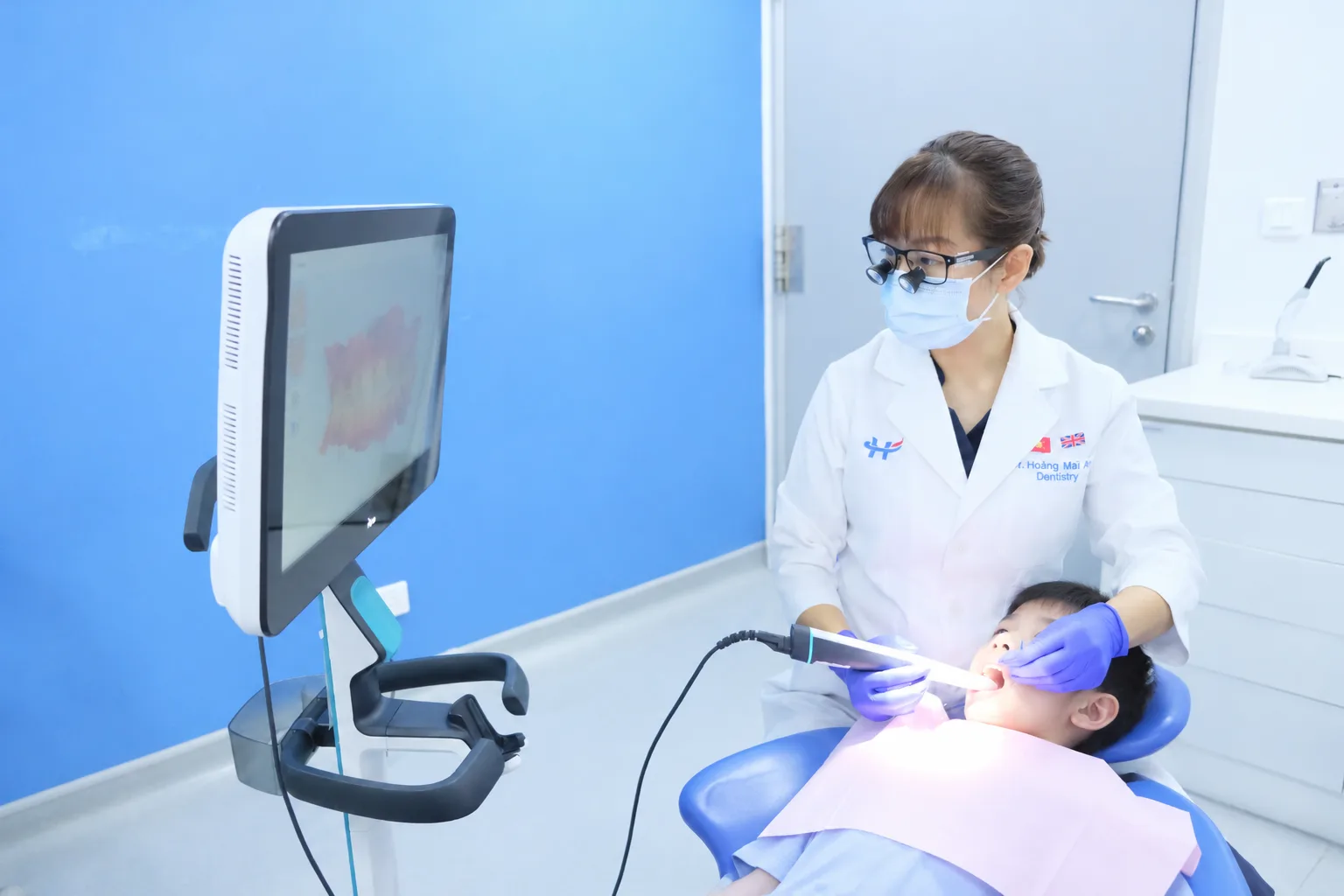
During an examination at the Department of Dentistry & Orthodontics at Hanoi French Hospital, Dr. Hoang Mai Anh noticed uneven tooth eruption on the two sides of the upper dental arch. X-rays confirmed that the permanent teeth were present but had not yet erupted. The upper jaw was also narrow, leaving insufficient space for the teeth to emerge in their proper positions.
Dr. Mai Anh recommended early orthodontic intervention through upper jaw expansion to create additional space for the permanent teeth.
The advantages of early palatal expansion in children
Dr. Hoang Mai Anh explains: “In growing children, the midpalatal suture has often not yet fused, making it more favorable to expand the upper jaw.
Unlike dental arch expansion achieved mainly by tipping the teeth outward, skeletal expansion works by separating the midpalatal suture, increasing the width of the upper jaw’s skeletal base.
Taking advantage of this growth stage, when the midpalatal suture has not yet fused, upper jaw expansion is generally more favorable than in adults. This helps widen the upper jaw, create additional space for permanent teeth, and improve the relationship between the upper and lower teeth.
Invisalign palatal expander (IPE) – A modern palatal expansion solution using 3D printing technology
For N.L.A., Dr. Mai Anh selected Invisalign Palatal Expander (IPE), a palatal expansion system custom-designed using digital scanning and 3D printing technology.
Unlike traditional expanders that rely on a manually adjusted expansion screw, IPE uses a series of pre-designed appliances that gradually apply expansion forces according to the treatment plan.
Key advantages include:
- No daily screw adjustments required: Eliminates the need for parents to manually turn an expansion screw each day.
- Customized design: Each appliance is tailored to the individual child’s dental arch.
- Removable: Makes oral hygiene easier when used as directed by the orthodontist.
- Less bulky design: Without a traditional expansion screw, the appliance helps minimize certain inconveniences during daily activities.
- Relatively short active expansion phase: Typically lasting a few weeks, depending on the severity of the upper jaw constriction and the individual treatment plan.
Dr. Hoang Mai Anh recommends that parents arrange dental checkups for their children during the mixed dentition stage rather than waiting until all baby teeth have been replaced.
Early detection of issues such as a narrow jaw, misaligned or crowded teeth, and delayed tooth eruption allows the orthodontist to assess the child’s development and determine the most appropriate timing for intervention.