
 Tiếng Việt


The patient presented to the Emergency Department at Hanoi French Hospital with a four-day history of right calf pain following his flight to Vietnam for a holiday. He had no fever, trauma or local infection. His medical history indicated that he had taken anti-inflammatory medication and painkillers for two days without improvement.
On examination, doctors noted swelling of the right calf and ankle edema. His D-dimer level was elevated at 6.3 mg/L (reference range: 0–0.5 mg/L), raising suspicion of thrombosis in this clinical context. Doppler ultrasound subsequently confirmed deep vein thrombosis in the right lower limb, extending proximally into the upper two-thirds of the superficial femoral vein.
The patient was promptly admitted for monitoring, anticoagulant therapy and symptomatic treatment. Further investigations were also performed to assess for pulmonary embolism.
Echocardiography showed elevated pulmonary artery pressure and grade I left ventricular diastolic dysfunction. Computed tomography pulmonary angiography (CTPA) revealed thrombi in multiple pulmonary artery branches on both sides, with near-complete occlusion of the left S3 and S4 segmental branches and signs of right ventricular strain. Testing for thrombophilia also detected a positive lupus anticoagulant, indicating the need for further evaluation for antiphospholipid syndrome, a condition that can increase the risk of blood clot formation.
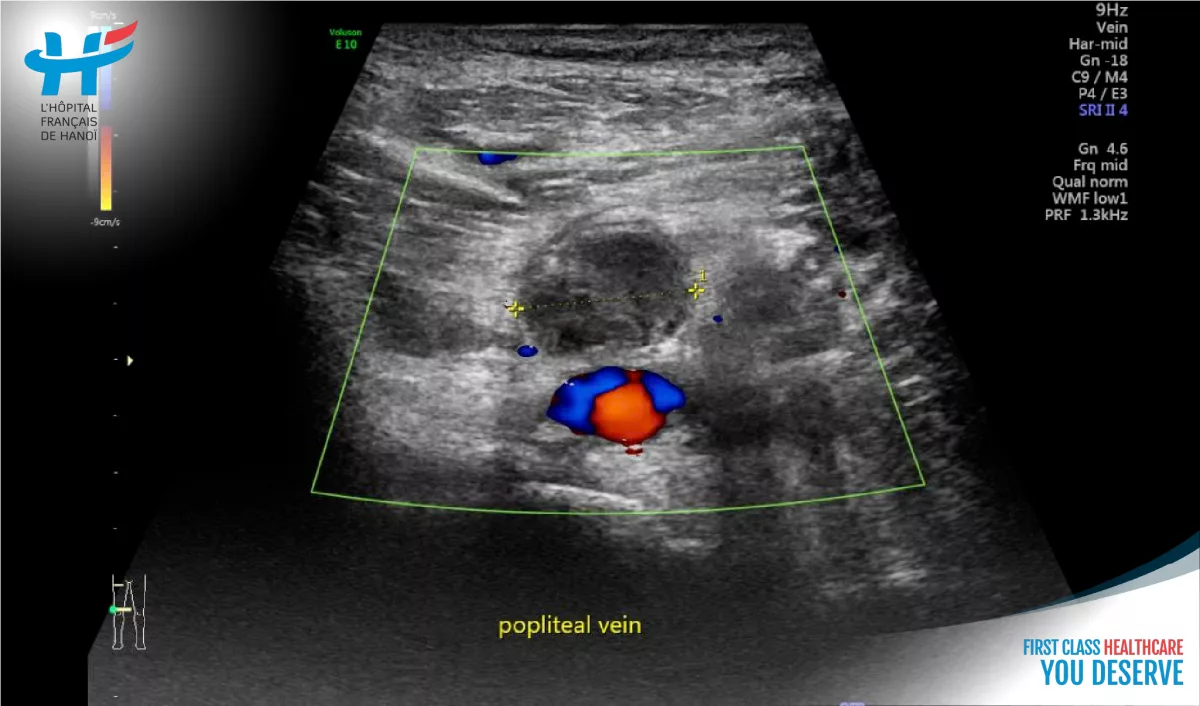
Commenting on the case, Dr. Pham Thu Thuy, Clinical and Interventional Cardiology Department at Hanoi French Hospital, said: “The patient had no known history of thrombotic problems. Fortunately, he sought medical care and the condition was detected promptly.”
After just four days of inpatient treatment and a further five days of health monitoring at his hotel, the patient’s condition had improved and stabilized. Follow-up CTPA showed a marked reduction in the thrombus burden, with only a small residual thrombus remaining. He was therefore assessed as medically fit to fly home.
Explaining the mechanism, Dr. Thuy said: “Deep vein thrombosis of the lower limbs occurs when a blood clot forms and grows within the deep veins of the legs. If part of the clot breaks off, it can travel through the bloodstream, pass through the right side of the heart and reach the lungs, where it may block one or more branches of the pulmonary arteries.
When a pulmonary artery is blocked, blood flow through the lungs suddenly decreases. This can lower blood oxygen levels and increase pressure within the pulmonary arteries, making the heart work harder to pump blood. Without prompt diagnosis and treatment, patients may develop serious complications, including right ventricular failure, low blood pressure, shock or even death.”
People should seek prompt medical assessment for unexplained pain and swelling in one leg, particularly when symptoms begin suddenly or progress rapidly following a long flight or prolonged immobility due to illness. Warning signs of a more serious condition include sudden shortness of breath, chest pain, coughing up blood or fainting.
The risk of thrombosis increases when venous blood flow slows, blood vessel walls are damaged, or an underlying condition makes the blood more prone to clotting. People with cancer, pregnant women, those with inherited clotting disorders or vascular abnormalities, people who are overweight or obese, and smokers may be at increased risk.
Before embarking on long journeys, people with risk factors should undergo an individual assessment to determine appropriate preventive measures, including anticoagulant prophylaxis when indicated. Tourists should also regularly move their ankles and flex and extend their legs during journeys lasting more than six hours by car, plane or other forms of transport.
